
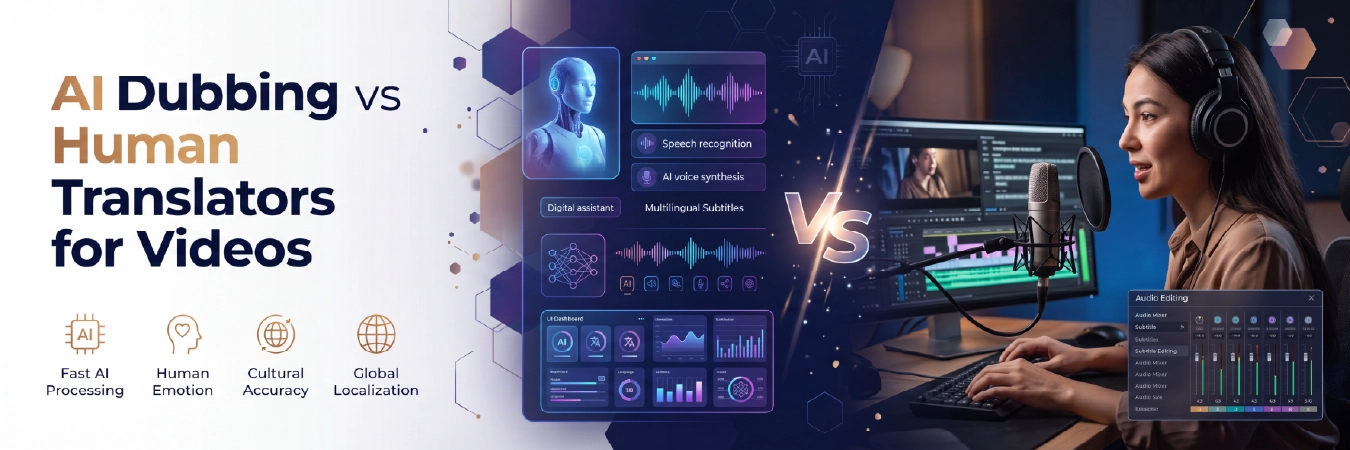
AI Dubbing vs Human Translators for Videos: Which Is Better?
Video content has become one of the most effective ways for businesses to communicate with global audiences. Whether it is product demonstrations, corporate training, marketing campaigns, e-learning modules, or entertainment content, organizations are increasingly looking to make their videos accessible in multiple languages. This growing demand has fueled the adoption of AI dubbing vs human translators for videos, prompting businesses to evaluate which approach delivers the best balance of speed, quality, and authenticity.
Artificial intelligence has made remarkable progress in voice synthesis, speech recognition, and machine translation. At the same time, professional human linguists continue to play a vital role in delivering culturally accurate and emotionally engaging multilingual content. Choosing between AI dubbing and human translation is not about identifying a universal winner—it is about selecting the right solution based on your content, audience, and business objectives.
In this blog, we’ll compare both approaches, explore their strengths and limitations, and help you determine the best option for your localization strategy.
What Is AI Dubbing?
AI dubbing is the process of using artificial intelligence technologies to automatically translate spoken dialogue into another language and generate a synthetic voice that closely matches the original speaker’s tone, pace, and style.
Modern AI dubbing platforms combine several technologies, including:
- Automatic Speech Recognition (ASR)
- Neural Machine Translation (NMT)
- AI Voice Cloning
- Text-to-Speech (TTS)
- Lip-sync optimization
The result is a localized video that can be produced significantly faster than traditional dubbing workflows.
AI dubbing is particularly useful for organizations producing large volumes of content that require quick multilingual distribution.
Understanding Human Voice Over Services
Professional human voice involve experienced translators, localization experts, voice actors, sound engineers, and quality reviewers working together to create a localized version of the original content.
Unlike AI-generated voices, professional voice artists understand:
- Emotional delivery
- Cultural nuances
- Humor and idioms
- Regional accents
- Brand personality
- Audience expectations
This makes human dubbing the preferred choice for content where authenticity and emotional connection are critical.
AI Dubbing vs Human Translators for Videos: A Detailed Comparison
| Feature | AI Dubbing | Human Translators & Voice Artists |
| Speed | Very Fast | Longer turnaround |
| Cost | Lower for large-scale projects | Higher due to manual work |
| Emotional Expression | Limited | Excellent |
| Cultural Adaptation | Basic | Highly Accurate |
| Creativity | Limited | High |
| Voice Quality | Improving rapidly | Natural and expressive |
| Scalability | Excellent | Limited by available resources |
| Best For | Internal videos, e-learning, product updates | Marketing, films, corporate messaging |
AI offers efficiency and scalability, while human expertise provides authenticity and linguistic precision.
Benefits of AI Dubbing Services
Many organizations are adopting AI dubbing because they significantly reduce localization time and operational costs.
Some of the major advantages include:
1. Faster Turnaround
AI can process hours of video content within minutes or hours rather than days or weeks.
This makes it ideal for:
- Product launches
- News updates
- Corporate announcements
- Internal communication
- Learning management systems
2. Lower Localization Costs
Businesses creating multilingual content at scale can reduce production costs by minimizing manual recording sessions.
3. Easy Updates
If product information changes, AI-generated voiceovers can be updated quickly without scheduling another recording session.
4. Consistent Voice
Voice cloning allows brands to maintain a consistent voice identity across multiple languages.
5. Scalability
Organizations can localize hundreds of videos simultaneously, making AI particularly valuable for global enterprises.
Common Challenges Faced by AI Dubbing Services
Although AI has advanced significantly, several common challenges faced by AI dubbing continue to affect quality in complex localization projects.
1. Limited Emotional Delivery
AI voices may sound natural, but they often struggle to express emotions such as excitement, empathy, urgency, sarcasm, or humor.
This can reduce viewer engagement in storytelling and promotional content.
2. Cultural Context
Machine translation may fail to capture:
- Local expressions
- Cultural references
- Industry-specific terminology
- Regional language preferences
Literal translations can sometimes create awkward or confusing dialogue.
3. Pronunciation Issues
Brand names, technical terminology, and proper nouns may not always be pronounced correctly by AI systems.
4. Lip Synchronization Limitations
Although AI lip-sync technology has improved, perfect synchronization remains difficult for many languages.
5. Quality Variations
The output quality often depends on:
- Original audio quality
- Speaker clarity
- Background noise
- Language pair
- AI model capabilities
Human review is still recommended before publishing important content.
Why Human Translators Over Services Still Matter?
Despite advances in AI, professional translators continue to provide value that technology cannot fully replace.
1. Cultural Localization
Human experts adapt content for local audiences rather than translating word-for-word.
This includes:
- Idioms
- Humor
- Tone
- Regional preferences
- Business etiquette
2. Brand Voice
Professional linguists preserve your company’s messaging and brand identity across every language.
3. Accuracy
Technical industries such as healthcare, legal, manufacturing, and finance require precise terminology where even small translation errors can create serious consequences.
4. Emotional Storytelling
Human voice actors naturally deliver emotion, making them ideal for:
- Advertisements
- Corporate films
- Customer testimonials
- Entertainment content
- Product storytelling
When Should You Choose AI Dubbing ?
AI dubbing services is an excellent choice when:
- You need rapid multilingual content production.
- Budget is a primary concern.
- Videos are primarily informational.
- Large content libraries require localization.
- Internal training videos need quick updates.
- Educational content requires multiple language versions.
For these use cases, AI offers exceptional efficiency.
When Are Human Voice Over Services the Better Choice?
Professional human voice remain the preferred option when your content demands authenticity and emotional impact.
Choose human localization for:
- Television commercials
- Corporate branding videos
- Marketing campaigns
- Customer-facing promotional content
- Executive leadership messages
- Films and documentaries
- High-value product launches
In these situations, audience trust and engagement often outweigh production speed.
The Hybrid Approach: Combining AI and Human Expertise
Many organizations are now adopting a hybrid localization workflow that combines AI efficiency with human expertise.
A typical workflow includes:
- AI generates the initial translation.
- Professional linguists review and edit the content.
- Voice artists record critical sections where emotion matters.
- Localization experts perform quality assurance.
- Final audio is synchronized with the video.
This approach reduces costs while maintaining high-quality multilingual communication.
Connect with Filose for AI Dubbing Services
The debate around AI dubbing vs human translators for videos is not about replacing people with machines. Instead, it is about understanding where each solution performs best.
AI dubbing is transforming multilingual video production by making localization faster, more scalable, and cost-effective. However, human expertise remains essential for preserving cultural context, emotional expression, and brand authenticity.
Businesses seeking high-quality global communication should evaluate their content type, target audience, and localization goals before deciding on the right approach. A carefully planned combination of AI technology and professional localization experts often delivers the best results.
At Filose, we help businesses reach international audiences through intelligent localization solutions, combining advanced AI technologies with experienced language professionals. Whether you need fast multilingual video localization or premium-quality voice-over services, our team ensures your message resonates naturally across languages and cultures.
Connect with us at sales@filose.com.
Ref. No – FLB07261075