
Why Data Collection for AI Training is Critical for AI Success?
Artificial Intelligence has moved far beyond experimentation – it is now at the core of business transformation across industries. From predictive analytics to intelligent automation, AI systems are only as powerful as the data that fuels them. At the heart of every successful AI model lies one essential foundation: data collection for AI training.
Without high-quality, well-structured and relevant data, even the most advanced algorithms fail to deliver meaningful results. In this blog, we explore why collection for AI training is critical for AI success, how it impacts performance and what businesses must do to build robust AI systems.
What is Data Collection for AI Training?
Data collection for AI training refers to the process of gathering, organizing and preparing data that is used to train machine learning and AI models. This data can come from various sources such as customer interactions, sensors, databases, images, videos, or text.
The goal is simple: provide AI systems with enough relevant information so they can learn patterns, make predictions and improve decision-making over time.
Unlike traditional software, AI systems are not explicitly programmed – they learn from data. This makes collection for AI training not just important, but absolutely fundamental.
Why Data Collection for AI Training is the Backbone of AI Success
AI models rely on patterns, correlations and historical data to function effectively. If the input data is flawed, incomplete, or biased, the output will be equally unreliable.
Here’s why data collection for AI training plays such a critical role:
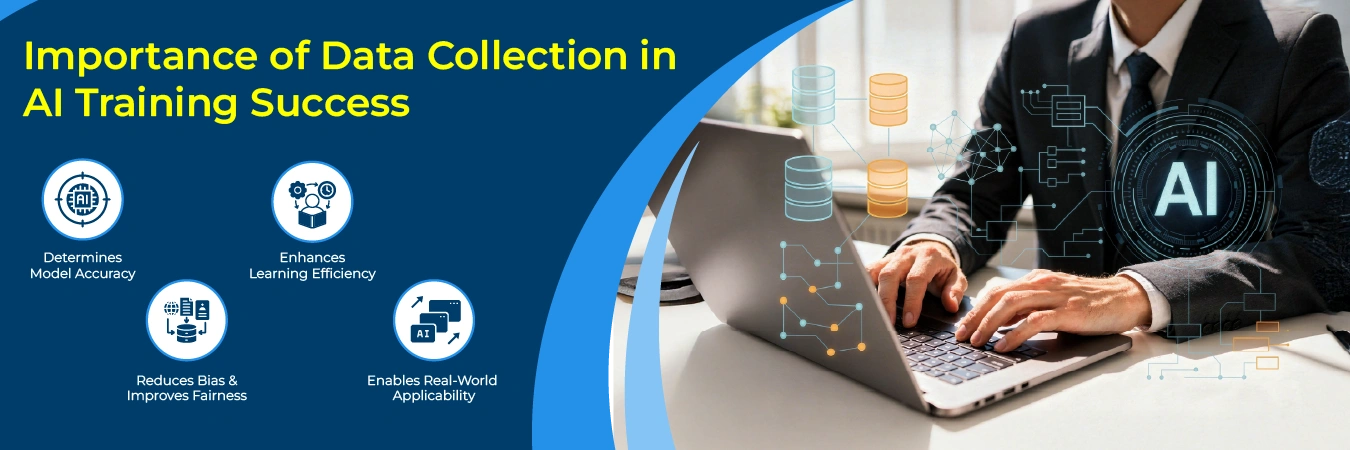
1. Determines Model Accuracy
The accuracy of an AI model depends directly on the quality of data it is trained on. Clean, labelled and diverse datasets enable models to make better predictions and reduce errors.
2. Reduces Bias and Improves Fairness
Poor data collection practices can introduce bias into AI systems. Proper collection of data for AI training ensures diversity and inclusivity, leading to fair and ethical AI outcomes.
3. Enhances Learning Efficiency
Well-structured datasets allow AI models to learn faster and require fewer iterations. This reduces development time and computational costs.
4. Enables Real-World Applicability
AI systems trained on realistic and context-rich data perform better in real-world scenarios, making them more reliable and scalable.
The Role of Data Collection for AI in Building Intelligent Systems
When we talk about collection for AI, it goes beyond simply gathering large volumes of data. It involves:
- Identifying relevant data sources
- Ensuring data diversity
- Maintaining consistency and accuracy
- Continuously updating datasets
Effective collection for AI ensures that models are trained on meaningful information rather than noise. This is particularly important for applications like natural language processing, computer vision and predictive analytics.
Understanding AI Data Collection: Types of Data Used
AI data collection involves gathering different types of data depending on the use case. Some common categories include:
- Structured Data
Highly organized data such as spreadsheets, databases and numerical records. - Unstructured Data
Text, images, audio and video data that require processing before use. - Semi-Structured Data
Data that falls between structured and unstructured formats, such as JSON or XML files. - Real-Time Data
Data collected from IoT devices, sensors, or live user interactions.
Each type plays a unique role in AI collection of data and combining them effectively leads to more robust AI models.
Challenges in Data Collection for AI Training
While collection of data for AI training is essential, it comes with its own set of challenges:
- Data Quality Issues
Incomplete, inconsistent, or noisy data can significantly impact model performance. - Data Privacy and Compliance
With increasing regulations, organizations must ensure ethical handling of user data. - Scalability
Collecting and managing large datasets requires infrastructure and expertise. - Annotation Complexity
Labeling data accurately is time-consuming but crucial for supervised learning models.
Overcoming these challenges requires a strategic approach to this for AI training.
Best Practices for Effective Data Collection for AI Training
To ensure success, businesses should follow proven strategies:
- Define Clear Objectives
Understand what the AI model aims to achieve before starting the collection process. - Focus on Data Quality Over Quantity
Large datasets are useless if they lack accuracy or relevance. - Ensure Data Diversity
Diverse datasets improve model generalization and reduce bias. - Implement Robust Data Governance
Maintain compliance with data protection laws and ethical standards. - Continuous Data Improvement
AI models should be updated regularly with new data to stay relevant.
Leveraging AI Data Collection Services for Better Outcomes
Building in-house capabilities for AI data services can be resource-intensive. This is where specialized providers come in.
AI data collection services help organizations:
- Gather high-quality, domain-specific datasets
- Annotate and label data accurately
- Ensure compliance with global data standards
- Scale data operations efficiently
Partnering with experts allows businesses to focus on innovation while ensuring their data foundation remains strong.
Choosing the Right AI Data Collection Company
Selecting the right AI data collection company is crucial for long-term AI success. A reliable partner should offer:
- Domain expertise across industries
- Advanced tools and technologies
- Scalable collection capabilities
- Strong data security and compliance measures
- Customizable solutions based on business needs
An experienced AI collection of data company ensures that your AI models are built on a solid and reliable data foundation.
Future Trends in Data Collection for AI Training
The landscape of collection for AI training is evolving rapidly. Some key trends shaping the future include:
- Automated Data Collection
AI-driven tools are being used to collect and preprocess data more efficiently. - Synthetic Data Generation
Artificially generated data is helping overcome data scarcity and privacy concerns. - Edge Collection of Data
With IoT growth, data is increasingly being collected at the edge for real-time processing. - Ethical AI Practices
Greater emphasis on transparency, fairness and accountability in collection.
How Filose Supports Data Collection for AI Training
At Filose, we understand that successful AI begins with the right data strategy. Our expertise in collection of data for AI training enables businesses to build intelligent, scalable and high-performing AI solutions.
We offer:
- End-to-end AI collection of data services tailored to your business needs
- High-quality data annotation and labelling
- Multilingual and domain-specific collection
- Scalable solutions for global AI deployments
- Compliance with international data privacy standards
As a reliable AI collection company, Filose empowers organizations to unlock the true potential of AI through accurate, efficient and ethical data practices.
Conclusion
In the AI-driven world, data is not just an asset – it is the foundation of innovation. Data collection for AI training determines how well an AI system performs, adapts and scales in real-world scenarios.
Organizations that invest in robust collection for AI training strategies gain a competitive edge by building smarter, faster and more reliable AI systems. Whether through in-house efforts or expert AI collection of data services, the focus must always remain on quality, relevance and ethical practices.
If your goal is to create impactful AI solutions, it all starts with one thing—getting your data right. And that’s where Filose can help you lead the way.
To know more or to connect with us reach out to us at sales@filose.com.
Ref. No – FLB04261070
Contact Us
Are you looking for Language Services? Fill form for quick contact.