
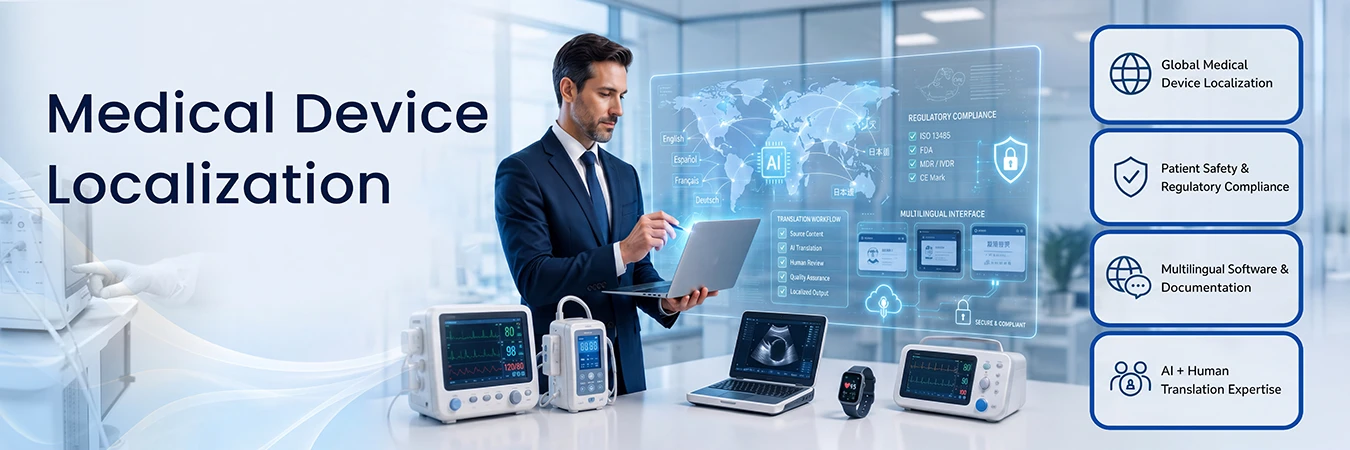
Medical Device Localization for Better Patient Safety
As medical devices are used across different countries, languages and healthcare systems, ensuring that every user clearly understands how to operate them is essential. Medical device localization goes far beyond translating words – it involves adapting user interfaces, software, instructions, labels, training materials, and regulatory documentation to meet the linguistic, cultural, and regulatory requirements of each target market.
For manufacturers, effective localization helps reduce the risk of misuse, supports regulatory compliance, and improves user confidence. For healthcare professionals and patients, it provides accurate, easy-to-understand information that contributes to safer device usage and better healthcare outcomes. As the global medical device industry continues to expand, investing in high-quality localization has become a critical part of delivering safe and reliable products worldwide.
Why Medical Device Localization Solutions Matter?
Launching a medical device internationally involves much more than translating a user manual. Every component that users interact with should be localized to ensure clarity, usability, and compliance.
Comprehensive medical device localization solutions typically include:
- Software and user interface localization
- User manuals and instructions for use (IFUs)
- Labels and packaging
- Safety warnings and precautions
- Mobile applications connected to medical devices
- Training materials
- Regulatory documentation
- Marketing and customer support materials
Localization ensures that healthcare professionals and patients receive information in a language and format they fully understand. Even small misunderstandings can affect the safe operation of diagnostic equipment, monitoring devices, surgical instruments, wearable medical devices, or home healthcare products.
In addition, localized content improves user experience by adapting measurements, date formats, symbols, terminology, and cultural preferences to the expectations of each market.
How to Choose the Right Medical Device Translation Service?
Medical content requires exceptional accuracy. Unlike general translation, a professional medical device translation service combines linguistic expertise with knowledge of medical terminology, engineering concepts, and regulatory expectations.
A quality translation process generally includes:
- Subject matter experts with medical knowledge
- Native-language linguists
- Consistent terminology management
- Quality assurance and linguistic validation
- Compliance with regional regulatory requirements
- Multi-stage review and proofreading
Medical devices often contain highly technical instructions that directly impact patient care. Poor translation may lead to confusion during installation, calibration, operation, cleaning, or maintenance.
Professional translation services help manufacturers maintain consistency across multiple languages while ensuring that safety information remains clear and accurate.
Best Practices for Medical Devices Translation
Successful medical devices translation requires structured workflows that prioritize both linguistic quality and patient safety.
Some recommended best practices include:
Maintain Terminology Consistency
Medical terminology should remain consistent across manuals, software, packaging, and regulatory documentation. Approved glossaries and terminology databases help avoid inconsistencies.
Localize User Interfaces
Many modern medical devices include touchscreen displays or companion software. Buttons, menus, alerts, and notifications should be carefully localized without affecting software functionality.
Preserve Regulatory Accuracy
Different countries have unique regulatory expectations regarding product information, warnings, and labeling. Localized content should align with the applicable regulatory requirements of the target market.
Perform Linguistic Testing
Software interfaces and embedded systems should be tested after localization to verify that translated content displays correctly and functions as intended.
Adapt Visual Content
Icons, graphics, diagrams, screenshots, and instructional videos may also require localization to improve understanding across different regions.
Ensure Readability
Healthcare professionals work in fast-paced environments where clear communication is critical. Simple, accurate, and well-structured language improves comprehension while reducing the possibility of errors.
The Growing Role of AI and Human-in-the-Loop in Medical Device Translation
Artificial intelligence is transforming multilingual content management across many industries, including healthcare. AI medical device translation can significantly accelerate translation workflows, particularly for large volumes of technical documentation, helping manufacturers reduce turnaround times while maintaining consistency across multilingual content.
Some advantages include:
- Faster translation turnaround
- Improved consistency across repetitive content
- Efficient terminology suggestions
- Reduced processing time for updates
- Better scalability for multilingual product launches
While AI delivers significant gains in speed and efficiency, medical device content demands a Human-in-the-Loop (HITL) approach to ensure the highest levels of quality and safety. Rather than replacing human expertise, AI works alongside professional linguists, subject matter experts, and regulatory specialists who review, validate, and refine AI-generated translations.
Medical device documentation often contains complex technical terminology, regulatory language, and safety-critical instructions where even minor inaccuracies can lead to compliance issues or user misunderstandings. Human reviewers provide the contextual understanding, domain expertise, and linguistic precision that AI alone cannot consistently achieve, ensuring translations remain accurate, culturally appropriate, and aligned with regional regulatory requirements.
A Human-in-the-Loop workflow combines the speed and scalability of AI with expert human oversight. AI handles repetitive and high-volume translation tasks, while experienced linguists focus on terminology validation, contextual accuracy, consistency, regulatory compliance, and final quality assurance. This collaborative approach enables organizations to accelerate global product launches without compromising the quality, reliability, or patient safety standards that medical device documentation demands.
How Localization Improves Patient Safety?
Patient safety is one of the strongest reasons for investing in high-quality medical device localization.
Proper localization helps:
- Reduce user misunderstandings
- Improve correct device operation
- Support safe installation and maintenance
- Minimize interpretation errors
- Enable faster training for healthcare staff
- Improve patient confidence when using home healthcare devices
- Ensure critical safety warnings are clearly understood
For example, a localized insulin pump interface, patient monitor, or diagnostic device allows healthcare professionals to operate equipment more confidently, especially in emergency situations where quick decision-making is essential.
Similarly, patients using medical devices at home benefit from instructions that are written in their native language, helping them follow operating procedures correctly and recognize important safety precautions.
Challenges in Medical Device Localization
Although localization offers significant benefits, manufacturers often face several challenges during multilingual product deployment.
Common challenges include:
- Managing large volumes of technical documentation
- Maintaining consistency across multiple languages
- Keeping pace with frequent product updates
- Meeting regional regulatory requirements
- Localizing embedded software interfaces
- Coordinating translation across global product teams
Addressing these challenges requires well-defined localization workflows, standardized terminology, quality assurance processes, and collaboration between engineering, regulatory, medical, and linguistic experts.
Why Medical Device Manufacturers Need a Long-Term Localization Strategy?
Localization should not be treated as a one-time activity performed before product launch. Medical devices continue to evolve through software updates, regulatory changes, new product features, and expanding global markets.
A structured localization strategy helps organizations:
- Support multilingual product lifecycle management
- Accelerate international market expansion
- Maintain translation consistency across releases
- Simplify documentation updates
- Improve operational efficiency
- Strengthen regulatory readiness
- Enhance customer satisfaction and user trust
By integrating localization into the product development lifecycle, manufacturers can ensure that multilingual content remains accurate, current, and aligned with product changes.
Connect with Filose for Reliable Medical Device Localization Services
Delivering safe, user-friendly medical devices to global markets requires more than accurate translation—it requires localization that supports usability, regulatory compliance, and clear communication.
At Filose, we help organizations streamline multilingual content through advanced localization workflows that combine language expertise, technology, and quality assurance. From software interfaces and user manuals to regulatory documentation and technical content, our localization solutions are designed to support global product launches while maintaining accuracy and consistency across every language.
As healthcare technology continues to evolve, effective medical device localization remains a key factor in improving patient safety, enhancing user experience, and enabling manufacturers to confidently reach international markets.
Connect with us at sales@filose.com.
Ref. No – FLB07261073