
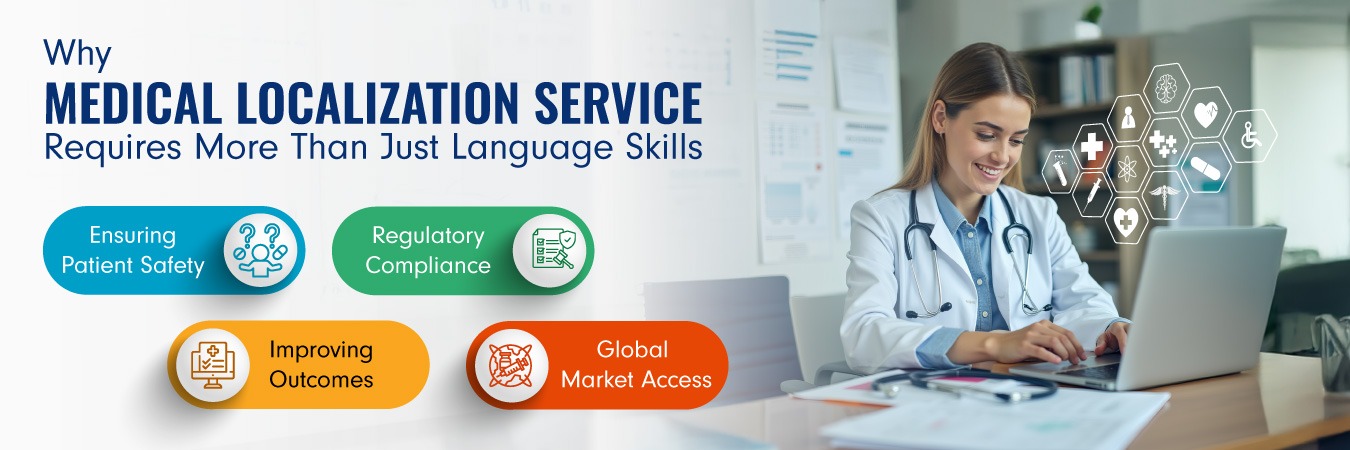
Why Medical Localization Service Requires More Than Just Language Skills
Today, healthcare has become a global profession. From pharmaceutical companies to core healthcare providers like hospitals, everyone looks forward to expanding their geographical base, opening new ventures, and becoming a global brand.
However, in today’s hyperconnected, digital age, globalization demands personalization, to which the medical domain isn’t an exception.
This is where medical localization, with language at its core, comes into play.
Medical localization services help healthcare providers connect with their target audiences in a market, unlocking local opportunities.
However, localization, particularly in the medical field, cannot be about language skills alone. It is a much broader phenomenon and a combination of several factors that form its quality. Let’s see the factors that prove how medical localization is more than just language in the modern context.
Medical Localization and Its Significance
Medical localization involves adapting medical content like medical device manuals, clinical trial documents, software interfaces, patient information leaflets, training manuals, patient instructions, dosage information, etc. It doesn’t aim to merely translate content but localize it to fit the linguistic, cultural, and regulatory context of a particular region.
Here are some factors that make medical translation and localization vital.
- Ensuring Patient Safety
This is the foremost and the most crucial aspect. Accurate localization helps prevent potentially dangerous misunderstandings concerning dosage instructions, device usage, diagnostic information, etc., helping safeguard patient health. When localized appropriately in the local context, while ensuring technical accuracy, patients understand what’s written or what’s being told, correctly.
- Guaranteeing Regulatory Compliance
Healthcare is a highly regulated industry. It comprises stringent protocols, standards, and laws, complying with which is mandatory for every associated organization. Localization ensures each document meets the necessary strict legal and health authority requirements. Complying with the required standards and conditions helps avoid costly fines, legal issues, or product recalls that can cost a fortune!
- Improving Patient Outcomes
For a patient to adhere to a particular prescription or treatment, it is necessary that they understand it. Localization helps do that by providing patients with the information they need in their local language and a culturally relevant format. Comprehension forms the first step toward achieving better outcomes. Accurate localization plays a crucial role in it.
- Facilitating Global Market Access
Medical localization also benefits from the commercial viewpoint. It can serve as a bridge connecting pharma and medical device companies with the local audiences and market players. Thus, localization can open frontiers and pave the way for a global presence.
Now that you have seen why medical localization matters, let’s understand why medical localization services are more than just the language expertise, as is usually considered.
Going Beyond Language: 10 Other Crucial Aspects of Medical Localization Services
From profound technical knowledge to rigorous quality assurance, here’s what medical translation and localization services must cover beyond language.
1. Deep Technical Understanding
Healthcare has its unique terms and terminologies, just like every other domain. Each of them might not necessarily have an equivalent in the target language. Therefore, medical service providers must have a deep, comprehensive understanding of the anatomy, pharmacology, and clinical procedures to ensure technically accurate localization.
2. Cultural and Ethical Sensitivity
Health-related communication can involve translating and localizing for sensitive topics like mental illness, lifecare, or reproductive health. While localizing content concerning these topics, localization experts shouldn’t be merely technically accurate. They must also be culturally sensitive to value local beliefs so that they avoid offending or confusing patients who would be consuming the content.
3. Compliance with Regulatory Requirements
Each country in the world has its distinct regulatory conditions when it comes to healthcare and pharmaceuticals. These require specific documentation formats and language use. Translators must align their translated documents with these standards to avoid approvals and costly delays, resulting from non-compliance.
4. Expertise in Medical Writing Conventions
Medical writing, translation, and localization follow specific stylistic norms like data formats, units of measurement, dosage expressions, and abbreviations across various countries. Localization specialists are expected to adapt these conventions accurately to ensure accuracy and comply with the prescribed standards.
5. Precision and Accuracy
Inaccuracies in medical localization can cause colossal damage, perhaps irreparable.Even a single mistranslated term can lead to critical consequences. For example, a dosage error or misinterpreted instruction could endanger lives! This is where precision and accuracy step in. These factors go beyond the language fluency of the translator. They also demand analytical thinking and domain expertise.
6. Software and Technology Integration
Those days when translations were fully manual are long gone. Today, we all live in the age of technology. Therefore, modern devices and healthcare platforms often include software interfaces, electronic instructions, and mobile apps. Accordingly, localization professionals must understand medical software terminology, UI/UX principles, and format compatibility. Together, these factors will help ensure effortless understanding and seamless user experiences.
7. Adaptation for Diverse Audiences
Localized healthcare or medical content isn’t meant for patients alone. It also serves other audience groups like doctors, pharmacists, biomedical engineers, medical researchers, etc. Each group has its unique expectations and requirements beyond accuracy. It involves adapting the language, technical sophistication, etc. Therefore, translators must know how to interpret complex feedback and integrate it into accurate, medically sound translated and localized documents.
8. Attention to Detail
Accuracy is the outcome of attention to detail. Therefore, translators and localization specialists cannot afford to commit even a single error, no matter how trivial it may be. Thus, every comma, figure, or word matters. Mistakes can lead to unimaginable disasters! Hence, localization also demands precision levels and a careful review that goes beyond proofreading. Each alphabet, word, punctuation mark, and the overall content must undergo multiple rounds of strict quality checks across various parameters.
9. Terminology Management
Medical science isn’t static. Instead, it evolves constantly. Accordingly, a localizer must possess exceptional research skills to stay updated on new protocols, abbreviations, and terms. Besides, they must be able to manage and maintain centralized, approved terminology databases to ensure absolute consistency across each document for a particular project.
10. Quality Assurance and Validation
As stated in point number eight, medical localization must involve several rounds of stringent quality checks, review, proofreading, and back translation. The quality check specialist should also be proficient in ISO standards, regulatory validation protocols, and medical quality management systems to ensure quality and appropriate validation.
Need a Reliable Medical Localization Company?
Then, partner with Filose. We are one of the leading medical localization experts with years of experience and continuously evolving expertise. Our team comprises healthcare SMEs, translators, localization experts, quality check specialists, and project managers who deliver even the most complex and critical requirements effortlessly.
We are known for our accuracy, speed (thanks to AI medical localization), and the blend of technology and manual expertise that we leverage. Besides, our experts ensure quick turnarounds while maintaining the expected levels of precision and quality.
Would you like to know more about our medical localization services? Please email us at sales@filose.com and discuss your requirements in detail.
Ref. No – FLB01261069
Contact Us
Are you looking for Language Services? Fill form for quick contact.