
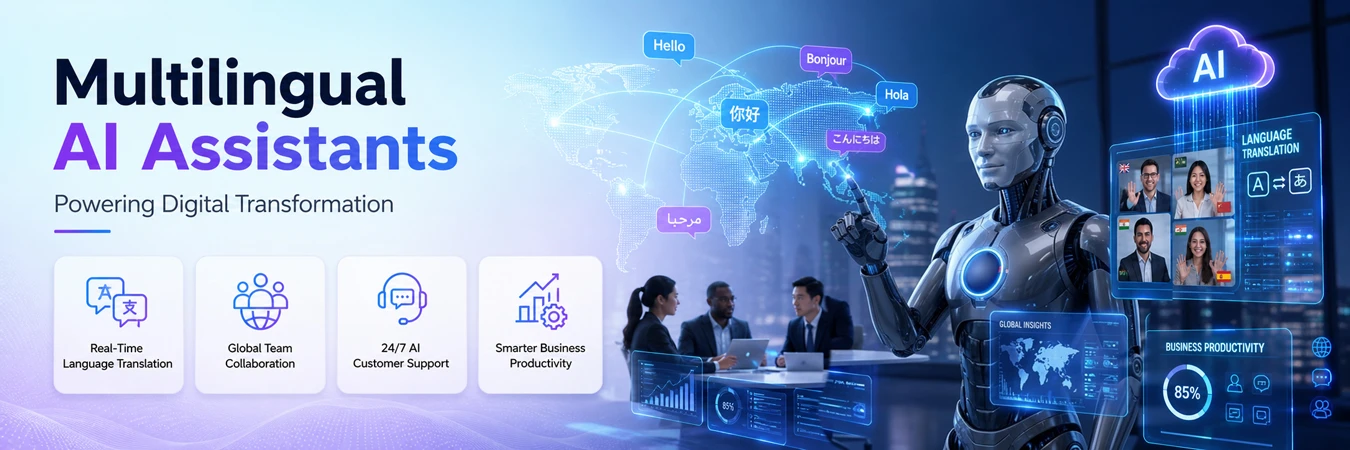
Multilingual AI Assistants and Their Role in Digital Transformation
Digital transformation is no longer limited to adopting new technologies. Businesses today need to communicate effectively with customers, employees, and partners across multiple languages and regions. As organizations expand globally, language barriers can slow collaboration, impact customer experience, and reduce operational efficiency.
This is where multilingual AI assistants are transforming the way organizations operate. By enabling seamless communication across languages, these intelligent systems help businesses improve productivity, enhance customer engagement, and support global growth strategies. From customer support and virtual meetings to internal collaboration and knowledge management, multilingual AI solutions are becoming an essential component of modern digital transformation initiatives.
In this blog, we explore how multilingual AI assistants are driving innovation, improving communication, and helping organizations succeed in multilingual environments.
What Are Multilingual AI Assistants?
A multilingual AI assistant is an AI-powered virtual assistant capable of understanding, processing, and responding in multiple languages. Unlike traditional chatbots that are often limited to a single language, these advanced solutions use Natural Language Processing (NLP), machine learning, and language models to facilitate communication across diverse linguistic audiences.
Organizations use multilingual AI assistants for various purposes, including:
- Customer service automation
- Employee support and knowledge management
- Meeting assistance and transcription
- Language translation and localization
- Sales and marketing engagement
- HR and onboarding support
As businesses continue to globalize, multilingual AI assistants help ensure consistent communication regardless of the user’s preferred language.
Understanding Multilingual AI Assistant Capabilities
One of the key reasons businesses are adopting AI-powered communication solutions is the wide range of multilingual AI assistant capabilities available today.
Modern multilingual AI assistants can perform much more than simple translation. They can understand context, recognize intent, and generate accurate responses tailored to the user’s language and cultural preferences.
Key Capabilities Include:
1. Real-Time Language Translation
AI assistants can translate conversations instantly, allowing teams and customers speaking different languages to communicate without delays.
2. Speech Recognition Across Multiple Languages
Advanced AI systems can recognize spoken language, accents, and dialects, making voice interactions more natural and effective.
3. Context-Aware Conversations
Modern language models understand context, enabling assistants to provide meaningful and relevant responses rather than keyword-based answers.
4. Automated Content Generation
Organizations can use AI assistants to create multilingual emails, reports, summaries, and customer communications.
5. Intelligent Knowledge Retrieval
Employees can ask questions in their preferred language and receive accurate information from company knowledge bases.
6. Meeting Summaries and Action Items
AI assistants can transcribe meetings, identify action items, and generate multilingual summaries for distributed teams.
These multilingual AI assistant capabilities help organizations streamline communication while reducing the need for extensive manual translation efforts.
Why Every Business Needs a Multilingual AI Assistant?
As organizations increasingly serve international customers and operate across multiple regions, the need for a reliable multilingual AI assistant becomes more critical.
Language differences often create communication challenges that impact:
- Customer satisfaction
- Employee collaboration
- Knowledge sharing
- Sales effectiveness
- Operational efficiency
A multilingual AI assistant helps eliminate these barriers by creating a unified communication experience.
Benefits for Businesses:
1. Enhanced Customer Experience
Customers prefer interacting in their native language. AI assistants provide immediate responses without requiring businesses to maintain large multilingual support teams.
2. Improved Employee Productivity
Global teams can collaborate more effectively when language barriers are minimized.
3. Faster Decision-Making
Real-time communication enables quicker information sharing and problem resolution.
4. Reduced Operational Costs
Automation reduces dependency on manual translation and multilingual staffing requirements.
5. Scalability
Organizations can support customers and employees across multiple countries without proportionally increasing communication resources.
As digital transformation initiatives continue to evolve, multilingual AI assistants serve as a strategic investment for organizations seeking operational excellence and global reach.
How Best AI Assistants Multilingual Meeting Support Improves Collaboration?
The rise of hybrid and remote work environments has increased the importance of effective meeting communication. One area where AI is delivering significant value is through best AI assistants multilingual meeting support capabilities.
Global organizations frequently conduct meetings involving participants from different countries and language backgrounds. Traditional communication methods often lead to misunderstandings, incomplete information sharing, and reduced participation.
AI-powered meeting assistants address these challenges by providing real-time language support.
Features of AI-Powered Meeting Support
- Live Transcription
Conversations are converted into text instantly, improving accessibility and record keeping.
- Real-Time Translation
Participants can view meeting content in their preferred language while discussions are taking place.
- Automated Note Taking
AI assistants capture key discussion points and decisions without requiring manual note-taking.
- Action Item Tracking
Tasks and responsibilities are automatically identified and documented.
- Meeting Summarization
Post-meeting summaries can be generated and shared in multiple languages.
Business Impact:
Organizations using multilingual meeting support solutions benefit from:
- Higher employee engagement
- Better knowledge retention
- Reduced communication errors
- Improved collaboration across regions
- Increased meeting productivity
By eliminating language-related obstacles, AI assistants help teams focus on strategic discussions rather than communication challenges.
The Growing Importance of Multilingual AI Assistants for Meetings
The adoption of multilingual AI assistants for meetings is accelerating as organizations seek better ways to manage global collaboration.
International teams often face difficulties such as:
- Language misunderstandings
- Delayed communication
- Inconsistent documentation
- Missed action items
- Limited participation from non-native speakers
Multilingual AI assistants help overcome these issues through intelligent language processing and automation.
Common Use Cases
1. Cross-Border Project Meetings
Project teams located in different countries can communicate effectively without relying on human interpreters.
2. Customer and Partner Discussions
Businesses can engage international clients more confidently while ensuring accurate communication.
3. Executive Meetings
Leadership teams receive multilingual summaries that improve visibility and decision-making.
4. Training Sessions
Organizations can deliver multilingual learning experiences for employees worldwide.
5. Compliance and Documentation
Meeting records can be generated accurately and consistently across languages.
As businesses continue expanding globally, multilingual AI assistants for meetings are becoming a critical tool for maintaining effective communication and collaboration.
Multilingual AI Assistants and Customer Experience Transformation
Customer expectations are changing rapidly. Today’s customers expect immediate, accurate, and personalized support in their preferred language.
Multilingual AI assistants enable organizations to meet these expectations by providing:
- 24/7 multilingual support
- Instant query resolution
- Personalized recommendations
- Consistent customer interactions
- Faster response times
Unlike traditional support models, AI assistants can handle large volumes of customer interactions simultaneously while maintaining service quality.
This improves customer satisfaction while helping organizations optimize support operations.
Supporting Enterprise Digital Transformation
Digital transformation initiatives often focus on improving operational efficiency, enhancing customer experiences, and enabling data-driven decision-making.
Multilingual AI assistants contribute to all three objectives.
Operational Efficiency
Automation reduces repetitive communication tasks and accelerates information access.
Better Employee Experience
Employees can interact with systems and knowledge resources in their preferred language.
Global Expansion
Organizations can enter new markets without extensive investments in multilingual support infrastructure.
Data Insights
AI assistants generate valuable communication data that can be analyzed to improve business processes and customer engagement strategies.
As enterprises continue investing in AI-driven transformation, multilingual communication capabilities are becoming a key differentiator.
Challenges and Considerations
While multilingual AI assistants offer significant benefits, organizations should consider several factors before implementation.
Language Accuracy
AI models should be trained and optimized for the languages relevant to the business.
Data Security
Sensitive conversations and business information must be protected through robust security measures.
Cultural Context
Translation alone is not sufficient. AI systems should understand regional language nuances and cultural preferences.
Integration Requirements
Organizations should evaluate how AI assistants integrate with existing communication platforms, CRM systems, and enterprise applications.
Selecting the right technology partner can help businesses maximize the value of multilingual AI deployments while minimizing implementation challenges.
The Future of Multilingual AI Assistants
The future of multilingual AI assistants extends far beyond basic translation and conversational automation.
Emerging innovations include:
- Emotion-aware communication
- Advanced speech synthesis
- Contextual language adaptation
- Industry-specific AI assistants
- Multimodal communication support
- AI-powered collaboration ecosystems
As large language models continue evolving, multilingual AI assistants will become increasingly capable of supporting complex business interactions across languages and cultures.
Organizations that adopt these technologies early will be better positioned to compete in a globally connected digital economy.
Connect with Filose for Multilingual AI Expertise
Multilingual AI assistants are redefining how organizations communicate, collaborate, and serve customers in a multilingual world. By combining advanced language understanding, automation, and real-time communication capabilities, these solutions play a vital role in modern digital transformation strategies.
From enhancing customer support and enabling global teamwork to delivering intelligent meeting assistance and knowledge management, multilingual AI technologies are helping businesses overcome language barriers and unlock new growth opportunities.
At Filose, we help organizations leverage AI-powered multilingual communication solutions that improve collaboration, streamline operations, and support global business expansion. Whether you are looking to enhance customer engagement, optimize multilingual meetings, or accelerate digital transformation initiatives, multilingual AI assistants can become a powerful asset in achieving your business goals. Connect with us at sales@filose.com.
Ref. No – FLB06261072