
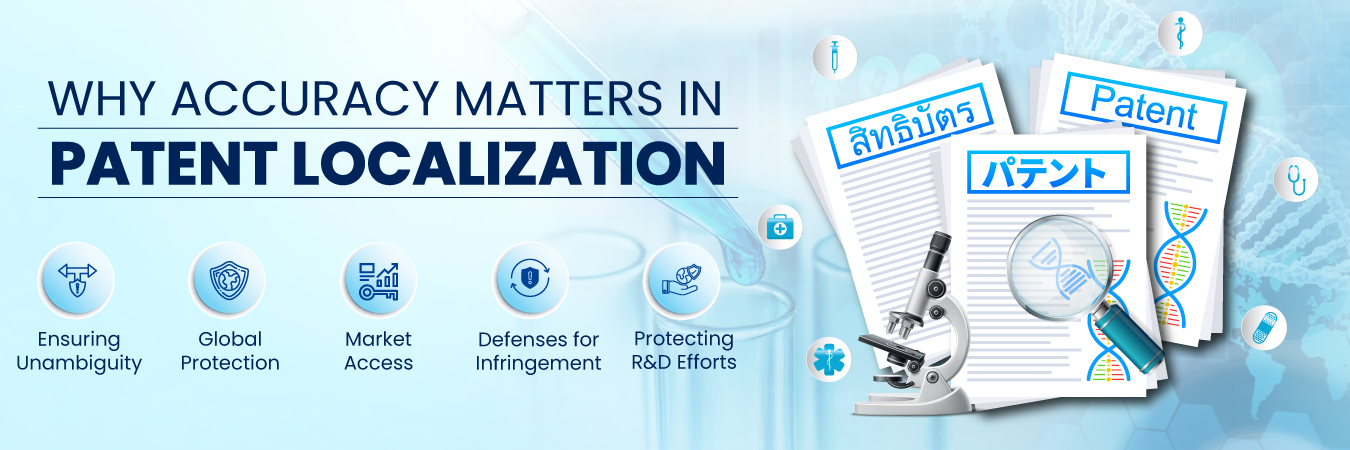
Patent Localization in Life Sciences & Pharma: Why Accuracy is Critical
In the pharma and life science sector, patents or intellectual property aren’t merely legal safeguards. They represent the efforts made by the company’s researchers to innovate something, and hence, they are the organization’s most valuable assets.
While filing a patent is a regular practice, filing just one isn’t sufficient in today’s highly globalized world. Companies looking to expand globally must localize their patent accurately across different jurisdictions. This is where patent localization steps in.
Patent localization isn’t just translation. Instead, it involves ensuring the legal, technical, and scientific meaning of the patent remains intact, even while adapting to different markets. A misplaced word or a mistranslated term can mean losing the patent rights!
So, let’s understand why accuracy in patent localization isn’t merely important but critical.
What is Patent Localization?
Patent localization involves adapting a patent document, including claims, legal wording, description, and drawings, from one language or jurisdiction to another. The process covers translation and contextual adaptation.
However, localization, as you would know, isn’t just about converting text from one language to another. It is a comprehensive process that also considers regulatory frameworks, legal terminology, technical conventions, and cultural nuances of a specific country.
For instance, the patent localized for Thailand should follow the standards of the Department of Intellectual Property, the department that manages patents in the country. The standards differ in format, phrasing, and scope from those of Japan, for instance, or France. Patent localization must consider these aspects.
While already complex, life sciences and pharma make patent localization even more complicated. Patents of this industry are full of scientific terminologies, gene sequences, experimental methods, dosage details, etc. Each aspect carries value. Thus, even the tiniest deviation can change or dilute the meaning, risking the patent.
5 Reasons Accuracy Matters in Patent Localization in Life Sciences and Pharma
Here’s why accuracy is critical in patent localization.
1. Ensuring Unambiguity in Patent Translation
Biotech and pharma patents describe highly complex innovations. Each term used in the description must be localized accurately. Inaccuracies can cause significant damage.
For example, mistranslating an enzyme name can misrepresent a molecular structure. On the other hand, a wrong preposition can alter a claim’s functional relationship.
When examiners, regulators, or even competitors interpret a patent, they depend on the language’s exactness. Inaccuracies can result in invalid claims, application rejections, or litigation challenges. Patent translation companies must be aware of these aspects.
2. Global Protection and Local Nuances
Life sciences and pharma companies often operate globally. Hence, they seek patent protection in different countries. But it must be noted that each country or jurisdiction has unique formatting rules, patent laws, and examination protocols and procedures.
Localization of patents ensures the patent language aligns with the local requirements. Inaccurate localization can lead to regional discrepancies that can, in turn, affect the company’s global patent filing strategy.
3. Compliance & Market Access in Patent Localization
Pharma patents are closely tied to regulatory approvals. Drug patents usually overlap with clinical data, formulations, and manufacturing methodologies filed with patent authorities.
Now, localizing a patent inaccurately might result in inconsistencies between the patent and the regulatory submission associated with it. It can raise red flags during review and put a question mark against the claim’s legitimacy or delay the company’s market entry.
This can be even more critical for time-sensitive products like vaccines. Any problems, including those resulting from inaccurate localization, can delay the company’s market entry. In situations like these, the company can lose millions and also access to patients.
4. Defenses Against Infringement and Litigation
Patent disputes are normal in the life sciences sector. However, if a company mistranslates or localizes its patent ambiguously, it may not hold up in court.
Accurate localization ensures that the original invention’s intent and scope remain clear, whether the company is defending or challenging. Courts also rely on the patent’s localized version, making linguistic precision just as crucial as the invention itself.
5. Protecting R&D with Patent Localization
Research and development in the pharma and biotech sector often span decades. Therefore, a company’s return on decades of investment significantly depends on the enforceability and longevity of the patents it registers.
Imagine a small localization error jeopardizing these safeguards! Even a seemingly small error in translation could expose a process to competitors, draining years of research and painstaking efforts down the drain. That’s why linguistic, legal, and technical accuracy is crucial, even during localization. It helps protect a company’s intellectual property and makes its patents even more competent and enduring in the target market.
Patent Translation and Localization – Best Practices
Patent translation is surely a complex process. Therefore, it demands careful planning and a professional approach that involves dealing with it strategically. After all, you have years of your research efforts and hard-earned intellectual property at stake. So, here’s how you can go about your patent translation project.
- Hire Patent Localization Experts: Don’t bring in experts after the damage is done or you’ve spent considerable time struggling to localize your patent. Involve patent translation companies early, preferably during the drafting stage, to anticipate linguistic and jurisdictional challenges.
- Maintain Terminology Consistency: Build a centralized glossary for processes, chemical names, and gene sequences across filings to ensure accuracy.
- Leverage Technology: Manual procedures and approaches don’t cut it anymore. Thankfully, you have technology. Thus, use translation memory and terminology management tools to deliver consistent translations. Nonetheless, ensure the localized product undergoes expert human review.
- Review and Validate: Don’t rely on a single quality check. Perform multi-tier reviews involving translators, patent attorneys, and technical experts before you finally submit the localized version of your patent.
- Stay Updated on Local Laws: Patent regulations evolve. Therefore, you must continuously monitor the patent-related laws and regulations in each jurisdiction you’ve filed the patent in to stay compliant.
Connect with Filose for Expert Patent Localization and Translation
One of the leading patent translation companies, Filose, has the experience, language skills, and domain expertise to translate patents accurately. We work with some of the most reputed life sciences and pharmaceutical companies globally, helping them translate patents across hundreds of Indian and foreign languages and multiple jurisdictions.
Would you like to know more about our patent localization in pharma or life sciences? Please email us at sales@filose.com.
Ref. No – FLB12251068
Contact Us
Are you looking for Language Services? Fill form for quick contact.